Your marksheet shows a CGPA of 8.3. The job application asks for percentage. Your friend's university uses a different formula. The placement cell says to use 9.5, but you've seen people use 10. Nobody gives you a straight answer.
This is the situation every Indian engineering and college student faces at least once — usually right before a deadline. This CGPA calculator handles everything in one place: CGPA from semester-wise SGPA, CGPA to percentage, percentage to CGPA, SGPA to CGPA, and CGPA to GPA on the 4.0 scale. It covers official formulas for VTU, Anna University, KTU, VIT, AKTU, KIIT, JNTUH, IPU, SRM, MAKAUT, CBSE, and more.
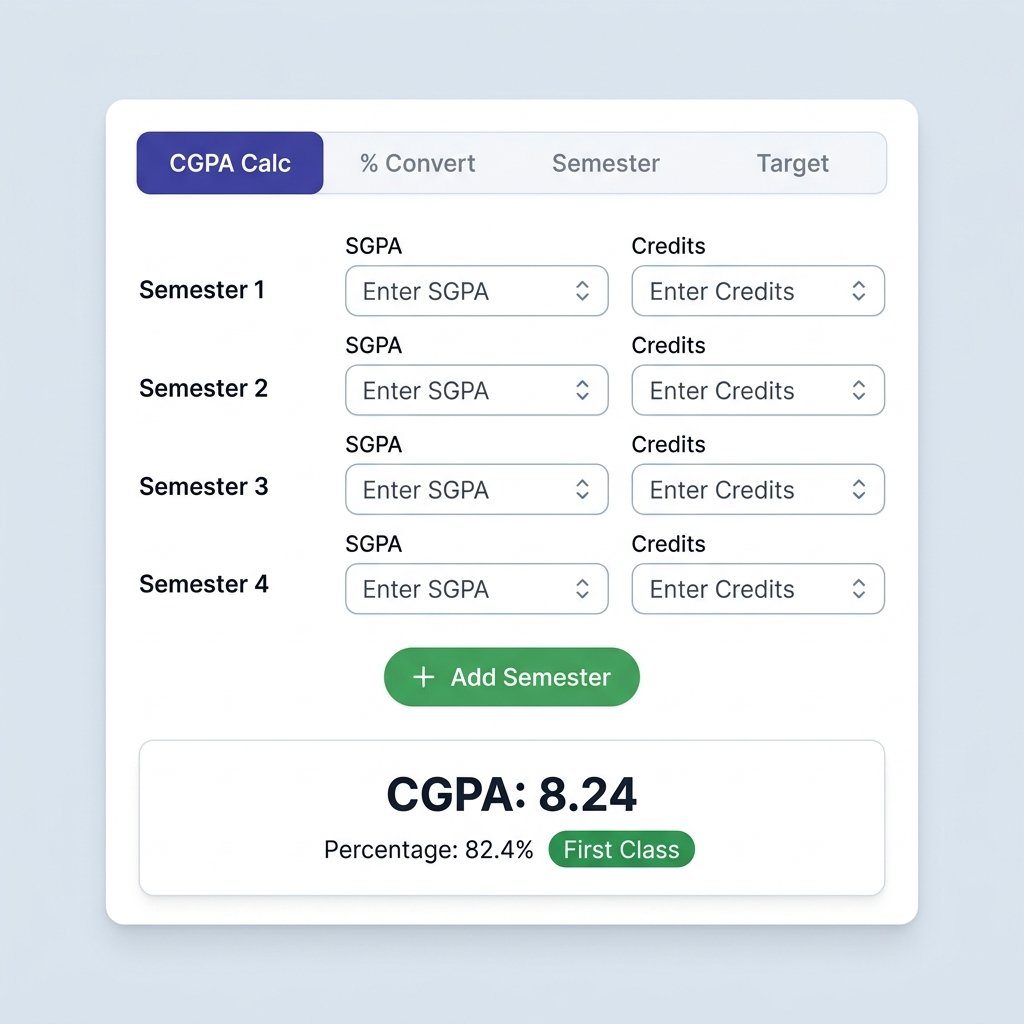
What Is CGPA and How Is It Calculated?
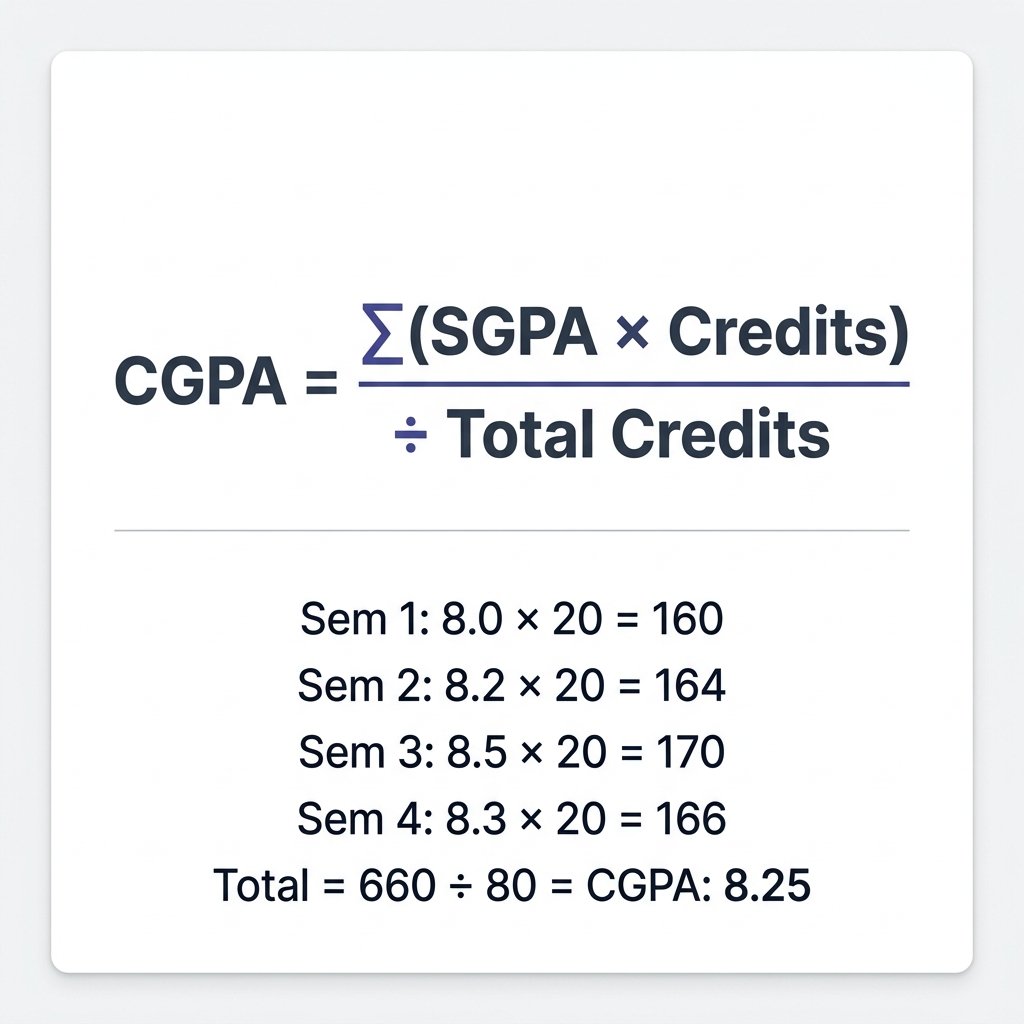
CGPA stands for Cumulative Grade Point Average. It measures your overall academic performance across all completed semesters, not just one. Every subject is assigned credit hours based on how many periods it runs per week. Your grade in that subject converts to a grade point — and the weighted average of all those grade points across all semesters is your CGPA.
Most Indian universities work on a 10-point scale. International universities typically use a 4.0 scale. CBSE uses a 10-point scale for school results but the conversion formula to percentage differs from most engineering universities.
SGPA vs CGPA: The Difference
SGPA is your GPA for one semester only. If you scored well in Semester 3 but struggled in Semester 5, your Semester 5 SGPA will be lower — but your CGPA reflects the cumulative picture. If all your semesters carry equal credit loads (common in engineering), CGPA is simply the average of all your SGPAs. When credit loads differ by semester, you need the weighted formula.
CGPA to Percentage: University-Wise Formulas
This is where most students get confused. There is no single universal formula. Every university has an officially notified conversion method. Using the wrong one on a job application or postgraduate form is a common and avoidable mistake.
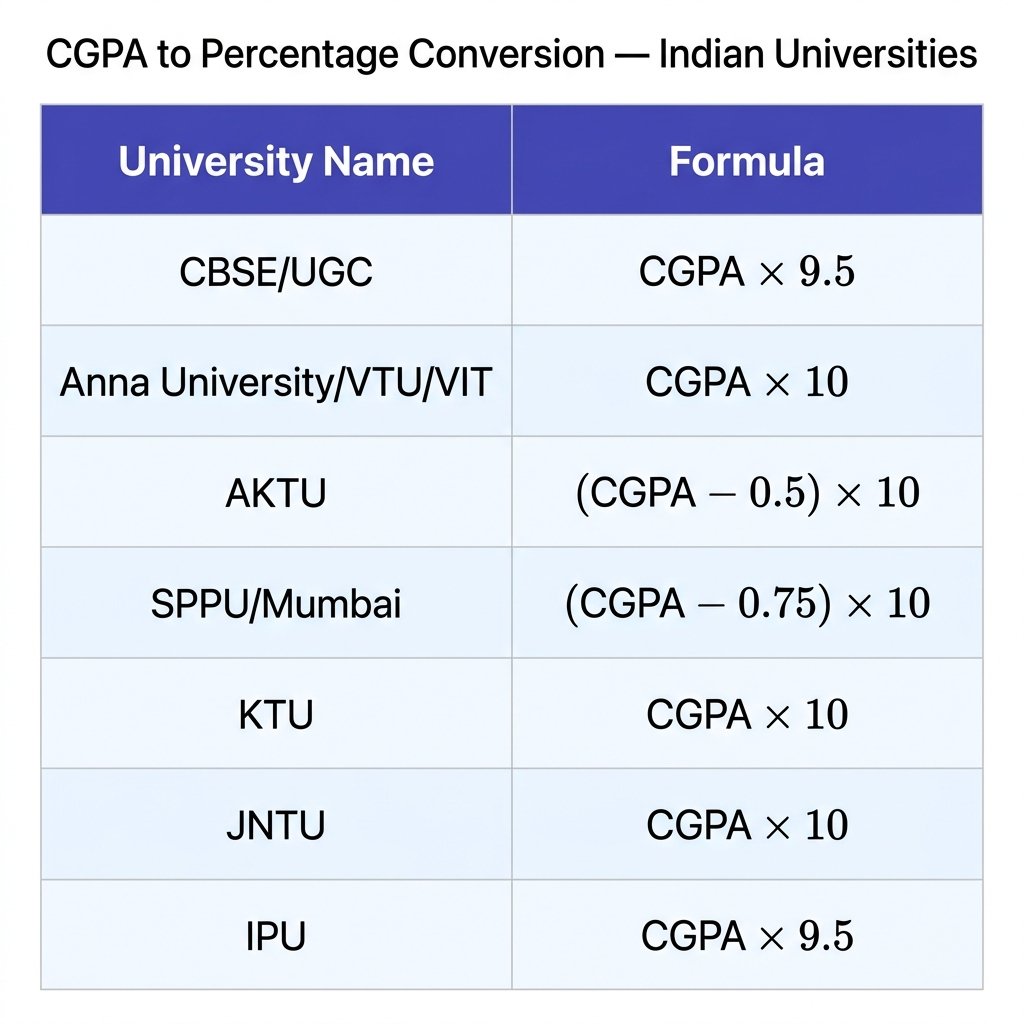
| University / Board | Official Formula | Example (CGPA 8.0) |
|---|---|---|
| CBSE / UGC / Delhi Univ / IPU / MDU / GNDU | CGPA × 9.5 | 76.0% |
| Anna University / VTU / VIT / IIT / NIT / JNTU / KTU / RGPV / Amity / LPU / Manipal / KIIT / BPUT / SRM | CGPA × 10 | 80.0% |
| AKTU / MAKAUT | (CGPA − 0.5) × 10 | 75.0% |
| SPPU (Pune) / Mumbai Univ / GTU | (CGPA − 0.75) × 10 | 72.5% |
| Mumbai Univ (CBCGS scheme) | (7.1 × CGPA) + 11 | 67.8% |
| RTU (Rajasthan Tech Univ) | (CGPA × 10) − 7.5 | 72.5% |
Standard / CBSE / UGC Formula — Percentage = CGPA × 9.5
The University Grants Commission recommends this as the default when no university-specific formula is prescribed. CBSE uses it for Class 10 and 12 results. Most central universities, Delhi University affiliates, MDU, and GNDU follow this. CGPA 8.5 → 8.5 × 9.5 = 80.75%
Anna University / VTU / VIT / IIT / NIT — Percentage = CGPA × 10
Anna University, VTU, VIT, most IITs, NITs, and SRM University use a straight multiplication by 10. CGPA 8.3 → 8.3 × 10 = 83%
AKTU (Dr. APJ Abdul Kalam Technical University) — (CGPA − 0.5) × 10
CGPA 8.0 → (8.0 − 0.5) × 10 = 75% · CGPA 7.5 → (7.5 − 0.5) × 10 = 70%
SPPU / Mumbai University / GTU — (CGPA − 0.75) × 10
CGPA 8.0 → (8.0 − 0.75) × 10 = 72.5% · CGPA 7.5 → (7.5 − 0.75) × 10 = 67.5%
KTU (APJ Abdul Kalam Technological University, Kerala)
KTU uses a 10-point grading scale. Standard conversion: Percentage = CGPA × 10. For placement purposes many companies accept CGPA × 9.5. Always check with your placement cell before submitting.
JNTUH / JNTUK / JNTUA — Percentage = CGPA × 10
JNTU universities follow CGPA × 10 for current CBCS batch students. For older batches (pre-CBCS), verify with your exam branch as the formula may differ.
CGPA to GPA: Converting for International Applications
If you're applying to universities abroad or taking GRE/GMAT, you'll need to express your CGPA on the US 4.0 scale. The standard conversion estimate is:
For credential evaluation services like WES (World Education Services), they perform their own calculation rather than accepting a self-converted number. If your target program requires a WES evaluation, let them do the conversion — don't submit a self-calculated 4.0 GPA.
CGPA Classification: What Your Grade Means
| CGPA Range | Classification | Practical Meaning |
|---|---|---|
| 9.0 – 10.0 | 🟢 Outstanding / Distinction with Honours | Top 1% — eligible for all scholarships, PSUs, research programs |
| 7.5 – 8.99 | 🟢 First Class with Distinction | Excellent — competitive for campus placements and top-tier grad schools |
| 6.0 – 7.49 | 🔵 First Class | Good — eligible for most company placements (6.0+ cutoff standard) |
| 5.0 – 5.99 | 🟡 Second Class | Average — some companies require 6.5+ |
| 4.0 – 4.99 | 🟠 Pass Class | Passing grade — most recruitment requires minimum 6.0 CGPA |
| Below 4.0 | 🔴 Fail / Below Passing | Below minimum passing threshold |
CGPA Calculation: Worked Examples
Example 1 — 8-Semester B.Tech (Equal Credits)
SGPAs: 7.8, 8.0, 8.3, 8.1, 8.5, 8.4, 8.2, 8.6 · All semesters: 24 credits
CGPA = (7.8+8.0+8.3+8.1+8.5+8.4+8.2+8.6) ÷ 8
Example 2 — 6-Semester Diploma (Unequal Credits)
Sem1: 7.5×18, Sem2: 7.8×18, Sem3: 8.1×20, Sem4: 8.0×20, Sem5: 8.4×22, Sem6: 8.6×22
CGPA = 971.4 ÷ 120
Example 3 — CGPA to 4.0 GPA for MS Application
CGPA: 8.4 (VTU, 10-point scale)
GPA = (8.4 ÷ 10) × 4
Example 4 — Reverse: Percentage to CGPA (AKTU)
You know your percentage is 75%. Formula: (CGPA−0.5)×10 = 75%
CGPA = (75÷10) + 0.5
Common Mistakes Students Make with CGPA
| Mistake | Why It's a Problem | What to Do Instead |
|---|---|---|
| Using CGPA × 9.5 for all universities | Wrong for VTU, Anna, AKTU, SPPU and many others | Check your university's official formula first |
| Averaging SGPAs without weighting | Gives wrong CGPA when semesters have different credits | Use CGPA = Σ(SGPA × Credits) ÷ Total Credits |
| Submitting self-converted GPA for WES | WES does its own evaluation; numbers may conflict | Let credential services do their own conversion |
| Ignoring arrears/backlogs in CGPA | Some universities reduce CGPA for failed subjects | Check your university's arrear policy |
| Confusing CGPA and SGPA on forms | CGPA is cumulative; SGPA is semester-specific | Read the form carefully — CGPA is the final figure |
| Using outdated conversion formulas | Universities occasionally update their formulas | Verify against the current examination ordinance |
Expert Tips
Always keep a screenshot of your university's official conversion notification. Job portals and HR teams sometimes challenge the formula you've used. Having the official circular as evidence saves time during document verification.
For placement-critical scores, verify with your placement cell. TCS, Infosys, Wipro, Accenture, and most mass recruiters accept UGC's ×9.5 formula when your university uses ×10 internally — but some don't. Your placement cell has the specific requirement for each company.
Model your CGPA before results come out. The Target CGPA tab works with projected SGPAs. If you know your approximate grades for the current semester, run the calculation before results are declared. It tells you whether you're on track for distinction, first class, or second class — and how much a bad semester can move the number.
CGPA above 8.0 on a 10-point scale is roughly equivalent to a US GPA above 3.2. This matters if you're building a profile for MS applications alongside your GATE score. Many US universities have a minimum GPA requirement around 3.0, and an 8.0 CGPA typically clears that bar. But verify — some programs ask specifically for a WES evaluation.
Don't conflate CGPA with marks. A CGPA of 8.5 under Anna University (converting to 85%) is not the same as 8.5 under AKTU (converting to 80%). The same number means different things at different universities. When comparing profiles, always compare percentage equivalents, not raw CGPA.
Frequently Asked Questions
⚡ Key Takeaways
- CGPA = Σ(SGPA × Credits) ÷ Total Credits — this is the standard formula for all Indian universities
- CGPA to percentage: CBSE/UGC uses ×9.5; Anna University, VTU, VIT use ×10; AKTU uses (CGPA−0.5)×10
- CGPA to GPA (4.0 scale) = (CGPA ÷ 10) × 4 — useful for MS applications abroad
- For WES credential evaluation, do not self-convert — let the service calculate
- Always verify the conversion formula with your university's official examination ordinance
- The same CGPA number can mean very different percentages at different universities
Conclusion
CGPA tells you how you've done across your degree. But the number on your marksheet rarely matches what job forms and university applications actually need — because the conversion formula varies by institution, and nobody explains this clearly until you're mid-application with a deadline approaching.
Use the CGPA calculator to get your verified number with the formula shown. Cross-check it against your university's official notification before submitting anywhere that matters.